* * * We are looking for an investor who is able to invest in the completion of development, obtaining the necessary certifications, and the launch of production and sales of the device. We offer favorable terms for entering the project. * * *


Obrázok
Fig.1 Photograph of the KogEN 20 prototype


Project Goals:

  1. Develop a prototype of a low-emission fully automated nano cogeneration unit:

    The cogeneration unit is a device intended for the combined production of heat and electricity. In cogeneration units with low electrical output (nano, up to approximately 2kWe), the device is primarily designed for heat production,
    and electricity generation is only supplementary. The electricity generation serves to:

     - reduce operational costs, as the price of generated electricity lowers electricity bills from the distributor

     - act as a backup in case of power outages from the distributor (planned shutdowns, failures, natural disasters, etc.)

    We strongly emphasize that operating the device primarily for electricity production without utilizing the produced heat is highly inefficient, and the price of the generated electricity will never be lower than from the distributor.

    Target parameters of the developed cogeneration unit:

     - maximum thermal output of the unit: 20 kW

     - maximum electrical output of the unit at 20 kW thermal output: 2 kWe

     - fuel: biomass in various forms (primarily cylindrical briquettes, pellets, other types of briquettes than cylindrical, wood chips, firewood logs - only with manual fuel loading)

     - fully automated operation in 24/365 mode

     - intelligent control system with remote control via the internet (while maintaining maximum security)

     - intelligent operation monitoring with data collection and archiving

     - optimization of the combustion process controlled by a lambda sensor

     - ability to connect the unit to an existing battery storage if the owner operates such a system (for example, an existing photovoltaic system)

     - easy maintenance

     - high modularity of the device (possibility of gradual investment into individual functional modules of the device and gradual upgrading to the full version)

     - long lifespan (using high-quality stainless steel for heat exchangers, high-quality refractory concrete for the combustion chamber)

     - high efficiency, at least 90% total efficiency

     - ability to install the device even in hard-to-reach places such as various basement spaces, etc.

  2. Produce a set of test prototypes of the developed device and obtain all necessary permits for manufacturing and selling the device:

    Produce a set of test prototypes on which the operational characteristics of the device will be tested in real operation.

    Obtain all necessary certificates and approvals required by current legislation to start manufacturing and selling the device for commercial purposes.

    Prepare the necessary manufacturing documentation.
  3. Launch serial production and sale of the device

    Secure manufacturing facilities

    Secure the necessary machinery

    Secure the required personnel

    Implement marketing

    Launch production and sale of the device

Description of the current project status:

  1. Basic Information:

    The project is currently in the first phase of the three described parts.

    The principle on which the device operates has been chosen. It is a steam cycle. Essentially, it is a thermal power plant with all the components that such a power plant must have.
    (Combustion chamber, steam generator, steam superheater, turbine, electric generator, steam condensers, economizer...)

    Currently, we have designed a 3D model of the prototype, created drawings, and produced a prototype of the device, see photo above.

    The prototype is running in test operation, during which many tests and measurements are being conducted to improve the prototype and achieve the target parameters.

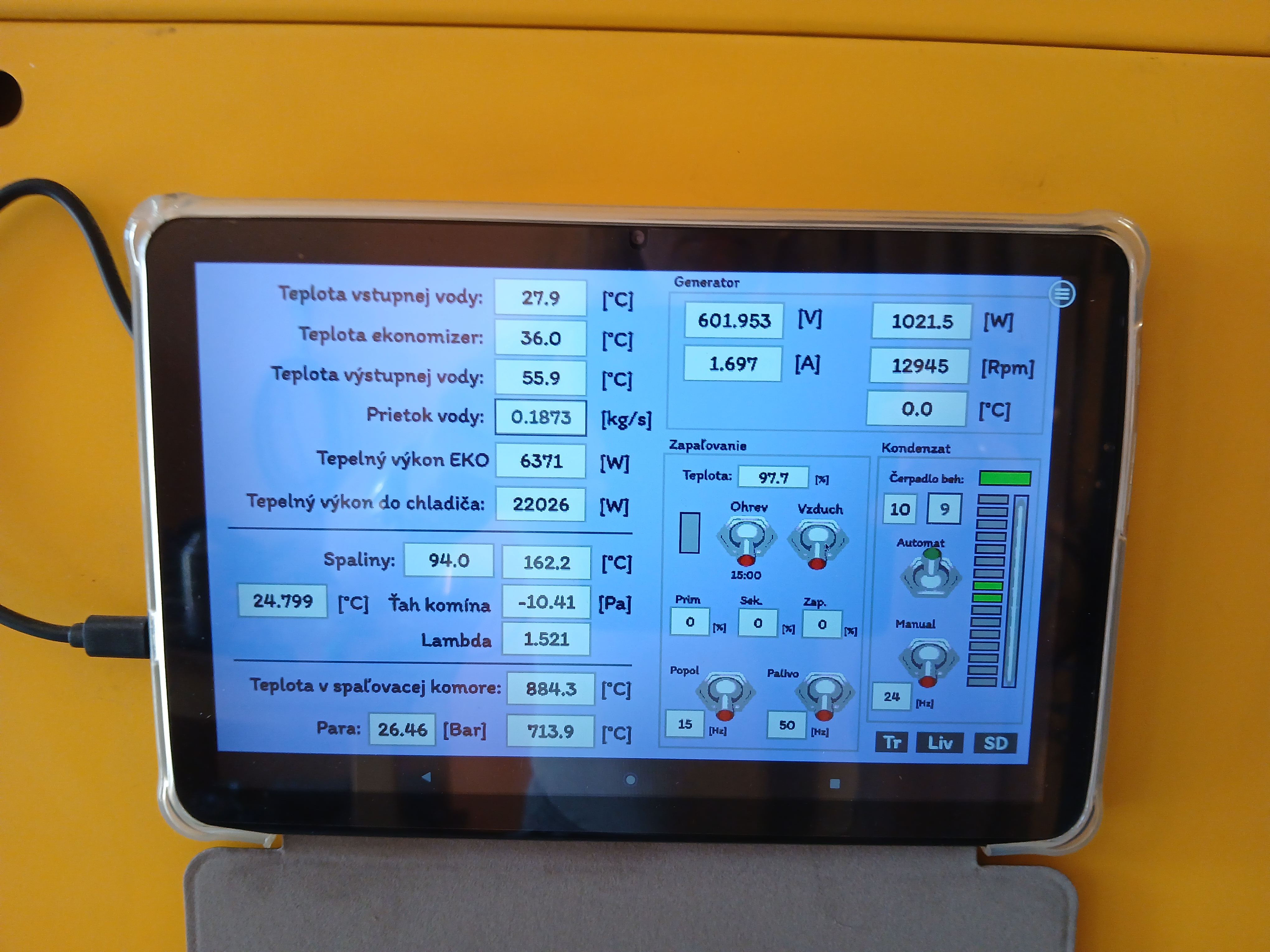
    For the purpose of monitoring operation and collecting data, a test control system has been created, which ensures the control of the prototype, data measurement, and their transmission to the SQL database. The following data are collected for monitoring the operation:

     - Temperature in the combustion chamber
     - Flue gas temperature leaving the chimney
     - Flue gas temperature entering the economizer
     - Ignition air temperature
     - Cooling water temperature at the inlet to the boiler
     - Cooling water temperature at the inlet to the economizer
     - Cooling water temperature at the outlet of the boiler
     - Steam temperature
     - Steam pressure
     - Generator winding temperature
     - Cooling water flow
     - Chimney draft
     - Lambda value in the flue gas
     - Turbine speed
     - Generator voltage
     - Generator current
     - Generator electrical output (calculated value)
     - Total thermal output (calculated value)
     - Economizer thermal output (calculated value)
     - Water level in the steam generator

    Obrázok
    >Fig.2 Photograph of the control panel during the test


    Fig.2 Photograph of the control panel during the test


    The recorded data from the entire testing period is stored in an SQL database and can be visualized using the web interface, which is available online in the section "Recorded Operational History".

    It is also possible to view live data from the operation of the device through the web interface in the section "Current Live Data".

    The device is used for the combined production of heat and electricity.


  2. Parameters Achieved So Far:

     - Maximum thermal output: 20 kWt (Higher values were reached, see attached charts)

     - Maximum electrical output: 1 kWe.

     - Total weight of the device without fuel and feeder: 850kg

     - A high degree of modularity has been achieved; the device can be built gradually from a basic setup that includes only the combustion chamber and the basic heat exchanger. This basic setup can be gradually expanded with a steam superheater, economizer, steam condensers, steam turbine with a generator, and automatic feeders. (The automatic feeder for cylindrical briquettes is not yet fully operational.)

     - The requirement for installation in hard-to-reach places has also been met. The device can be delivered in a disassembled state, with the heaviest part weighing no more than 60 kg.

     - The fuel hopper is designed to hold 300 cylindrical briquettes

     - Automatic ash removal into a designated ash collection container

     - Automatic fuel ignition

     - Three combustion air supply channels (primary, ignition - also serves as an additional primary and for burning pellets, secondary - regulates the lambda value in the flue gas)

     - Working fluid: distilled water, approximately 12 liters.

     - Total heat exchanger surface area: approximately 12 m² (steam reservoir, steam superheater, steam condenser, economizer).

    Obrázok
    Fig. 3 Graph of measured electrical output.


    Obrázok
    Fig. 4 Graph of thermal power.


    Obrázok
    Fig. 5 Graph of flue gas temperature exiting to the chimney.


    Obrázok
    Fig. 6 Combined graph of electrical output, temperature, power, steam parameters....

    Doplňujúce informácie:

    The device is highly flexible. It can be easily installed even in hard-to-reach places such as basements, as it is fully disassemblable.
    The heaviest part weighs approximately 60 kg.
    Every single part can be easily replaced in case of wear, which gives the device an extremely long lifespan.
    The unit is made from high-quality materials. The combustion chamber is made of heat-resistant concrete that withstands temperatures up to 1600 ºC, while all other parts are made of stainless steel.
    The steam superheater is made of heat-resistant stainless steel. The surface is finished with high-quality powder coating.

  3. What still needs to be done in the first phase of the project:

     - Optimize the steam turbine to increase its efficiency and achieve a maximum electrical output of 2 kWe. (Simulations using software are required)

     - Optimize the condensate pump, which pushes the condensate into the heat exchanger of the steam generator

     - Add condensate level sensing in the condensate tank

     - Add draft sensing in the ignition air feeder (to protect the heating element in case of fan failure - this is an additional safety feature, as the element has its own thermostat)

     - Optimize water level sensing in the steam generator for more precise level regulation (significantly affects steam generation parameters)

     - Commission the cylindrical briquette feeder and storage unit

     - Design a control interface board for sensors and control for commercial operation (the prototype uses industrial hardware intended for Unitronics automation, which is not cost-effective or space-efficient for commercial production)

     - Test the combustion of other fuel types (pellets, wood chips, log wood)

     - Program the commercial control system

     - Design an additional safety feature for the turbine to prevent it from spinning to critical speeds in case of generator failure (in case of loss of load)